Showing posts with label Family. Show all posts

Wednesday, January 28, 2015

The Land of Leprechauns

Thanks for all the emails and messages of congratulations and well-wishes!

In less exciting news, I’ve done a spot of traveling recently. After submitting the thesis I made a quick weekend trip to England, and then last Wednesday, one week ago today, I added country #27 to my slowly expanding list: Ireland. (You know life is good when traveling to a new country is less exciting than something else!) Along with leprechauns, gold, and four-leaf clovers, Ireland is the home of two strikingly handsome cousins: Levi and Luke… and their parents Justin and Jessica. We Goransons have some pretty great genes, wouldn’t you say? 

IMG_4624

Because I’m still here, I’ll make this post about my time in Ireland and do a subsequent post with some photos of England.

I’ve been in Ireland for one week today and, sadly, will say ‘goodbye’ to my newly introduced cousins tomorrow. But it has been a great week, filled with all kinds of adventures: from exploring ancient monastic ruins and touring Dublin to re-entering the chaotic magical world(s) of toddlers. Forget the pot of gold; here in Ireland and in this home, silence is golden.

Here are a few sights/experiences from my time here in neighbouring Ireland:

Other than meeting my wee cousins for the first time and reuniting with Justin and Jessica, one of the highlights of my time here came on the first day. I managed to squeeze onto a tour of three significant biblical papyri, P45-47, at the Chester Beatty Library in Dublin. These three papyri, which are (respectively) the four Gospels and Acts, the collection of Paul’s letters, and sections of Revelation, are some of the oldest extant manuscripts of the New Testament texts, dating back to c. 200-400 AD. That’s nearly two thousand years ago, people. Two thousand. Pretty cool. Photos weren’t allowed, as you can imagine, but here’s a link to the website if you want to see what they looked like.

This is St. Patrick’s Cathedral. It is smaller than most, but the  banners overhanging the choir stalls and the tiled floor add a colourful dimension not often found in Europe’s cathedrals.

IMG_4507

IMG_4514

IMG_4551

One of the many bridges of Dublin at sunset.

IMG_4579

This is at Trinity College, where the Book of Kells—a Latin copy of the four Gospels—resides. It was  created in c. 800 A.D. by monks on Iona, one of the western Scottish islands, before being moved to various places in Ireland when Viking invaders crushed the monastic community on Iona. Photos weren’t allowed, but trust me when I say, the Book of Kells is a stunning masterpiece, especially considering the when and where of its creation.

IMG_4724 - Copy

This is the Old Library at Trinity College. There were old books, old books, and more old books.

IMG_4736

One of the stained glass windows at Christ Church Cathedral in Dublin, which is otherwise unworthy of mention.

IMG_4484

My hosts have graciously taken me on several smaller outings during my stay here, but the big outing of our time together was last Saturday. It was, weather-wise, one of the most beautiful days of my time here across the Irish Sea. With an un-Irish early start, we wound our way to Glendalough (‘Valley of Two Lakes’), a village nestled in the Wicklow Mountains just south of Dublin. There a monastic community was formed some 1500-odd years ago, part of which still exists, at least in fabric if not in function.

IMG_4630

IMG_4647

Graveyard and chapel with Glencalo Valley in the background.

IMG_4654

Lower Glendalough Lake

IMG_4665

Goransons reunite!

IMG_4677

I’ve had a wonderful time here in the Land of Leprechauns, reuniting with family and meeting some of its newest—and certainly wildest—members.

Stay tuned for some sights of York and Durham next!

Saturday, January 11, 2014

Three Weeks of Winter

Christmas 2013, my first Christmas at home since my time as a student in Massachusetts, has come and gone.  As has my first New Years at home since, as far as I can recall, 2002.  The days were filled with seeing friends and family, celebrating holidays, watching the birds, working on puzzles, and always struggling to keep the Minnesota cold out—even before the ‘Polar Vortex’ made its way through!

Kamikaze Kim, Kristi, and I spent a couple of days together for the first time in a few years. 

IMG_1238

The Clan Goranson Christmas festivities ensued as they do every year, with all the normal chaos as one might expect to find in a family of this size… and character. 

IMG_1315

Much of my time was spent relaxing at home, hanging with Wilbur in front of the fire.  He was clearly overjoyed to have me there.

IMG_1429

One of the highlights was cross-county skiing in the mornings in the Back 40… usually in sub-zero temperatures.

IMG_1436

IMG_1361

IMG_1385

IMG_1445

If you look closely you can see the ice crystals on my eye lashes in the photo below.  It was an every day occurrence. 

IMG_1452

It was a great trip home.  So much so that I was sad to leave, despite the –55 degree wind chills the day before. 

Thursday, May 16, 2013

Patti and Mackenzie Days 6, 7, and 8: Glamis, Edinburgh and the Himalayas!

Now that Patti and Kenzie are probably in Minnesota and are nearing home, it makes sense that I should relate to you days six, seven, and eight of their trip here! 

Back to last Monday!

After having wonderful scones with clotted cream, butter and jam and Mackenzie’s fifth hot chocolate of the trip at the local fresh produce/farm store, we made our way to Glamis Castle, located in the tiny village of Glamis about an hour from St Andrews.  The castle is unique in that it is a currently lived-in castle by a ‘Lord Someone-or-Other’ and his family.  We toured about ten rooms of the castle, each entirely unique from the others, as well as the gardens covering the castle grounds.  The grounds need some work, but the building itself is spectacular!

IMG_8753

IMG_8750

After returning from Glamis, we grabbed a bite to eat and made use of the perfectly golden afternoon sun.  We walked down to the pier, explored the harbour, and enjoyed finding sea glass on East Sands beach, whilst another beautiful rainbow aided the already amazing scenery. 

In the photo below, Mackenzie is standing on the foundation of a church that dates to around 1100.  A wee bit older than Mazeppa!

IMG_8776

IMG_8804

Monday was a great day!

Tuesday was also a fabulous day, albeit of a very different kind.  On Tuesday morning we returned the car to the rental company (tear), and boarded the train to the big city of Edinburgh.  It was a day of shopping and sight seeing and eating and enjoying historic Scotland.  We walked up and down the Royal Mile, Princes Street, across bridges, in and out of churches, in and out of stores, amongst other things…

IMG_8871

We managed to stop by the Elephant’s Head, the ‘birthplace of Harry Potter’. 

IMG_8897

Patti enjoyed being back in Edinburgh and seeing sights that initially set her heart a pitter patter for Scotland, and Mackenzie enjoyed seeing a larger Scottish city entirely different than anything she’s ever seen!

Wednesday was another great day and, sadly, the final day of their journey.  We returned to the farm store and had a wonderful scone breakfast before heading to the St Andrews golf course called The Himalayas where we played a round of golf!  Ok, it is only a glorified putting course, but now they can both say that they’ve golfed in St Andrews!  It was a cold and windy day so that by the time we were finished, our fingers were all quite frozen! 

IMG_8915

After a fabulous fish and chips and ice cream sundae lunch nearby, we headed to the centre of town to finish last minute shopping before all the shops closed at five.  I think we went in and out of nearly every store in St Andrews in about two hours! 

After gathering all the last minute goods, we wandered down to the Cathedral ruins and enjoyed a walk through history one last time. 

IMG_8933

IMG_8941

Once sufficiently cold, again, we warmed up in The Central, the pub where they had their first lunch here last week, where Kenzie had her sixth (or was it her seventh?) hot chocolate of the trip!  She is now an expert Scottish hot chocolate taster. 

Like every night, we played a few rounds of Gin Rummy (yours truly won!) before heading to bed.  This morning they were collected by taxi at 3am and returned to the airport.  :(

It was an excellent trip for both of them, as well as for me! 

Who wants to come visit next? 

Thursday, August 30, 2012

Le Ville de Colpach-Haut

They may have had the same destination, but Catherine and Nicholas did not share the same place of departure.  While Catherine’s family came from the German border, Nicholas came from the French border; and based on my experience in Luxembourg and what little I know of the history of the region, my guess is that, while Catherine spoke German and Luxembourgish, Nicholas probably spoke French and Luxembourgish. 

Why, I ask you, has our family not maintained any of these languages?  I, for one, would like to know Luxembourgish, especially since I now know about 5 words in French and 10 words in German.  (And let me tell you… every single one of these words was used time and again on my trip last weekend, often intermingled in half German, half French sentences that were sometimes understood by the locals!)

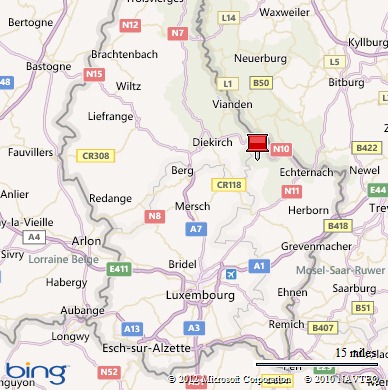
Anyway.  Nicholas was from the French border town of Colpach-Haut, also known by its German name, Obercolpach, and its Luxembourgish name, Uewerkolpech.  The pin on the map looks like it’s in Belgium, but trust me, it’s not.  It’s just that close. 

Map picture

IMG_4637

Before showing you the pictures of his tiny village, let me give you the run-down of his life.  There’s quite a lot to say!

Nicholas Bartholome was born in Colpach-Haut on March 27, 1832.  Like every child in this tiny farming village, Nicholas spend his childhood assisting his father on their family farm land just outside of town.  Before emigrating from Luxembourg to the United States in 1855, Nicholas also spent time working on several larger farms in Northern France.  I think it’s probably fair to say that he knew farming, and he knew it well. 

At the age of 23, Nicholas went to the United States, spending 62 days on a boat that landed him in New York City.  (If I were him I would have turned around and got back on that boat right then and there.  Alas, if I were him and I did that, I wouldn’t be here today.  So, perhaps he made the right decision after all!) 

He soon landed himself a job driving the horses that pulled the barges along the Erie Canal.  Imagine!  From there he went to Buffalo and worked on steamers, then to Chicago to drive horses that pulled street cars.  After Chicago came St. Louis and then Louisiana to cut timber.  When the Civil War broke out he went back to St. Louis and was drafted for the final six months of the war. 

He must have been getting his ‘big city kick’ during those wild 20’s years of his life.  He reminds me of someone I know… 

Eventually, he made his way to good ole’ Bellechester.  Perhaps he had had enough of the big city and decided to get back to what he knew best… farming.  In 1861, he bought a half a section of land, the deed of which was signed by Abraham Lincoln and is currently in the Wabasha Court House. 

It had been some time since he had heard from his family back in Luxembourg, so in 1868 (36 years old) he made a trip ‘home’.  There he found that his mother, Susan Miller Bartholome, had died, and he convinced his father, Peter, his brother, Dominic, and two sisters to return with him to Bellechester.  Now, think about this…. what must he have said about Bellechester to convince his family to uproot their entire lives and move across the Atlantic to live there with him?  Well, one sister wasn’t convinced and decided to stay in Luxembourg.   Smart woman.

After this, Nicholas keeps farming, meets Catherine for a cup of tea in Lake City a few times, watches a few sunsets over Lake Pepin with her, finally gets up the nerve to pop the question, gets hitched (her 20, him 40) by the 4th Bishop of St. Cloud, brings her back to the farm, and raises a family of 11 kids (including the 5th Bishop of St. Cloud and 1 Priest) right there on that same piece of land that many of us refer to as ‘The Farm’. 

He done good for himself.

IMG_4798

Nicholas died in 1918, at the age of 86 and after 45 years of marriage.

gage and ava 008

But after visiting Colpach-Haut this last weekend, the question I want to ask him is, ‘Why in the world did you ever leave?’… other than the fact that it’s smaller than the city block on which I currently live and there’s nothing around for miles and miles, except for other teensy-tiny villages smaller than the block on which I live nested in the distant valleys and hills!  Seriously, I knew it was small, but when the bus driver practically laughed at me when I expressed my intentions of being taken to Colpach-Haut, camera in hand, I thought for the first time, ‘there might literally be nothing there’! 

And sure enough!

So here it is, Colpach-Haut, in all its glory.  It’s smaller than Bellechester, but it has a bus stop… and a bus that goes through it… and… well, that’s about all that it has on Bellechester! 

Our photo tour today begins with the town pasture/junk yard.

IMG_4628

In the picture below is the town park… next to the town pasture/junk yard.  On the right hand side you see a white farm building which will feature in several of the upcoming photos.  (There weren’t many buildings to take pictures of, folks.) 

You can also see the colorful houses/flats just behind the white building.  Supposedly there are around 150 people who live in this town, but in reality, most of them must live in a row of houses that lead in to the ‘town’.  You can see some of them if you look back at the picture with the Colpach-Haut sign in it.  Imagine Bellechester… imagine a single row of houses lining the highway from the Bartholome Farm to the Catholic Church, at which point, there is a small cluster of 6-8 houses surrounded by fields.  That, my friends, is Colpach-Haut.  I suppose if Colpach-Haut was anything then like it is today, and if Bellechester was anything then like it is today, Bellechester was an upgrade!  Hard to imagine, I know.  Please don’t try too hard.  You could hurt yourself.

IMG_4629

Here’s practically the same picture.  Notice the city park on the left with its luxurious park bench (a cow ‘mooing’ in the background) and the farm buildings to the right.  Believe me when I tell you that everything that you see in this picture below truly is the ‘center’ of town.  Even if I pointed the camera twenty feet to the left or twenty feet to the right, nothing new would be added to the picture.  Other than a tractor moving a bale of hay. 

IMG_4557

If you don’t believe me, here’s the same buildings but from behind.  There are a couple houses hiding in the trees, the town pasture and park and the farm.

IMG_4581

Ah… but it’s when one travels to great heights that one can see what she could not see at the bottom of the deep blue sea, sea, sea. 

Huh?

IMG_4594

I suppose those people would be included in the Colpach-Haut population (where else would they belong?), but they’re not really in town.  They’re not town-folk like the people who live in the colorful houses/flats.  ‘No sir.  Those are city folk who live in that there Colpach-Haut town’.

IMG_4568

‘Ahah!  There are more houses’, you say!  Sorry, folks.  Those are the backs of the colorful houses you’ve already seen.  I’m telling you… there’s NOTHING in this town.

IMG_4570

In fact, there’s not even a church in this town.  They had share with the town next-door, Colpach-Bas, including the use of their cemetery.  As I did in Beaufort, I wanted to check out the cemetery and see what I could find.  We are told that Nicholas’ mother, Susan Miller Bartholome, was buried in that cemetery, as would have been any of his aunts, uncles, cousins, etc.

Upon my arrival I didn’t know there was no church or cemetery in Colpach-Haut.  How did I discover this shocking information, you ask?  Well… let me tell you.  I put my French to work like I have never needed to before… even in class! 

Upon my arrival, I spotted an older gentleman, approximately 65-70 in age, and I asked him, with my best French accent possible, ‘Where is the cemetery?’  Now, I knew that the word for cemetery in French is basically the same as it is in English, so there really should have been no problem in understanding me.  Nevertheless, the man could not understand my abysmal accent.  I probably pronounced ‘cemetery’ twenty different times, in as many ways as I could think of.  Then I resorted to another method.  Here’s my rendition in English of what I said IN FRENCH (and probably some German here and there).  It was a crowning moment…

‘…the cemetery (blank looks). No?  Ok.  I am dead.  Where am I?  (blank look)  People who are dead, where are they?  (blank look)  I am sick and then I die.  Where do I go?  (‘You want to sleep?)  No.  (Time to bring out the big dogs…)  Ok.  My great great grandfather lived here and then he went to the United States.  His mother is here.  She is dead.  Where is she?  (blank looks)’ 

And then… ‘Ahah!!  The cemetery!!!’ he says.  ‘Yes, the cemetery.  That’s what I said!’  ‘There is no cemetery here.  It is by the church in Colpach-Bas… blah… blah… blah (French that I didn’t understand)’.  The point is that I TOTALLY communicated IN FRENCH that my great-great grandfather grew up in Colpach-Haut and then emigrated to the States, but that his mother is buried there!  So what if it took nearly five minutes to do?   

Colpach-Bas is a town about the size of Bellechester, a.k.a larger than Colpach-Haut, about 1 mile down the road.  This is the church, built in 1733, and a tiny bit of the tiny cemetery attached.  Because it is the only church serving the two towns, similar to the church in Beaufort, it is most likely the church in which Nicholas was baptized, communed and confirmed, where he and his family attended mass regularly, and possibly where his parents were wed, etc. 

The cemetery there was similar to what I saw in Beaufort, with family plots, most of which date to the late 1800’s.  Unfortunately, I did not find any with the name of either Bartholome or Miller. 

IMG_4653

Notice the farm.  I’m telling you, it’s Bellechester’s twin!

IMG_4659

I did, however, find more Wagner’s and…

a Majerus!  It was seriously like Luxembourg is the Old Bellechester and Bellechester should be named, New Luxembourg. 

IMG_4646

So, that is Colpach-Haut, the birthplace of great-great-grandpa Nicholas, and possibly even great-great-great-grandpa Peter (who’s also buried in Bellechester).   Much like the region around Beaufort, the land surrounding Colpach-Haut is rolling bluff lands and valleys, covered in corn and alfalfa fields and pasture lands.  It’s a truly beautiful place… much like Bellechester, except that Colpach-Haut doesn’t have this:

IMG_3506

They should have a running list of all the names and dates of the Bart Boys that have farmed this land since Nicholas.  But ultimately, this sign is a tribute to Nicholas.

For sure, there was not much in Colpach-Haut, from whence he came.  Other than me.  A distance Luxembourger Bartholome…

IMG_4620 - Copy

…who will probably be talked about by the locals for years to come as the strange tourist who came to wander along their country roads and take pictures of their fields. 

It’s the equivalent of seeing an Asian tourist with a camera hanging around their chest walking around Bellechester.  You would definitely talk about that at the dinner table that night! 

So that’s it for the Bartholome’s in Luxembourg.  I wish I knew more and had more time to explore. 

How about we do a family reunion there in a few years?  Some of you could stand to work on your Luxembourgish skills.   Smile

Tuesday, August 28, 2012

Le Ville de Beaufort

Before I begin, let me make an apology to those of you who rely on the now ancient discovery of dial-up internet.  Pardon moi. 

Again, these next two posts are primarily intended for those members of the Bartholome family or anyone who might care where my great-great’s came from.  And they’re primarily of old buildings and corn fields.  So, if you don’t care about Luxembourg’s corn fields, don’t know a Bart, and have dial-up… feel free to not keep your internet on for the next five hours waiting for pictures to load!  I hereby release you from your reading obligations.  Tune back in a few posts from now!

Now, for those of you who do care about and love me… even if you don’t know a Bart or even where Luxembourg is…  Whether this is you or not, let me encourage you to look back at a previous post from last summer of the burial plots in the Bellechester cemetery.  I think it may help to jog your memory and set the stage a bit.  Here’s the link…Where I Come From.  Go there now.  Before reading on. 

Did you do your review?

Okay, then.  Let me introduce you to Catherine Jacobs, the woman who would become Catherine Bartholome and, ultimately, my great-great grandmother.  Also, before proceeding, allow me to say thanks to Carroll Bartholome for passing on all of the information that has been collected on the Bart family over the years! 

Catherine Jacobs was born on May 4, 1853 in Beaufort, Luxembourg.  Her father, William Jacobs, and mother, Catherine Plein, farmed a small plot of land outside of Beaufort and raised Catherine, as well as four other daughters and a son.  William Jacobs also worked on boats that travelled up and down the Rhine River in order to supplement his income.  At the suggestion of Catherine’s older sister, Anne, the Jacobs family moved to the Bellechester/Lake City region when Catherine was 14 years old.  Previous to this, she had had only two years of schooling, but spoke German and Luxembourgish, and would eventually learn to speak English.      

Le Ville de Beaufort is in a region of Luxembourg referred to as ‘Little Switzerland’ because of the lush green rolling hills. 

Map picture

The town itself is said to be between 1000-1500 people.

I tried to select pictures that give some indication of what Catherine experienced in her life in Beaufort as a child.  In those days there were, of course, no paved streets or street lights (at least not electric), and most of the buildings have been replaced.  There are, however, a few buildings and sights that remain now as they were then. 

IMG_4244

One such building is the Catholic Church of Beaufort, the only church in Beaufort, built in 1734.  Given as such, this is most-likely the church in which Catherine and her siblings were all baptized and celebrated their first communion, and probably attended mass regularly.  It may be the place where her parents were married and baptized, communed and confirmed.  Unfortunately, due to the timing of my trip and the fact that I needed to take an early bus back to Luxembourg City on Sunday morning, I was unable to attend mass there. 

Next time.

IMG_4242

Like most of the small villages throughout Luxembourg, Beaufort maintains a cemetery that dates back only to the mid-1800’s.  Unlike our cemeteries in the States, each person does not receive their own headstone, but is placed in a family burial tomb with the only designator often being the family name. 

IMG_4247

Since her parents and siblings emigrated to the States with her, the only Jacobs that would be buried in the Beaufort cemetery would be her grandparents and any aunts, uncles, or cousins.  I found one gravestone engraved with the name, ‘Jacobs’.  Could it belong to the same historical family?   I think so, but certainly can’t confirm it.  Had I had more time in country, I would have tried to track down the Jacobs family that maintains the plot.  Alas…

I won’t put the pictures up, but in the Beaufort cemetery were also tombstones engraved with the names: Gilsdorf, Buckholz, Klein, Arendt, and numerous Wagner’s.  Did anyone in our region not come from Luxembourg?  Another familiar name was discovered in the cemetery I searched on the other side of the country… but you’ll have to wait until the next post to find out what it is!

IMG_4262

The land surrounding Beaufort looks much like the land throughout Luxembourg: rolling rills, bluff lands, pasture lands, corn fields, alfalfa fields, and foliage.  I kept thinking to myself, ‘I’m in Whitewater.  I’m in Winona.  I’m in Wabasha.  I’m going through Wind Valley’.  I did not think to myself, ‘I’m in Hammond, Millville, La Crosse’ or any other place that does not begin with the letter ‘W’. 

Well, perhaps just a time or two.

Truly though, it was uncanny how utterly similar the two regions are: the bluff lands of the Mississippi and the bluff lands of the Rhine.  The Jacobs’ family moved from one country to another, but found exactly what they left. 

The roads in Luxembourg are well paved and wind around and around, taking the traveler from high upon hills overlooking crop lands and forests for miles on end, to low in the valley, surrounded by hills on all sides and a small river meandering through the middle.  Some villages are at the top of these bluffs, but the majority are nested in the valley below, close to the water and, but for the protruding church steeple here and there, hidden from view. 

IMG_4321

A cow, however, is rarely hidden from view.

IMG_4378

This is a farm about 1/2 mile outside of Beaufort.  Notice the church steeple of another town in the distance sticking above the trees on the far left of the picture.

IMG_4387

And then, only 1/4 mile later, the road begins its descent down through the forests into the valley below, literally via a series of switchbacks like can only be seen on mountainsides and in the Mississippi bluff lands… the places I like to call ‘home’.

IMG_4384

Back in Beaufort the church towers above the skyline on a sunny afternoon.  Isn’t it a nice picture when it is the church that one sees as a ‘skyline’ rather than a cluster of ugly, metallic looking, window reflecting office buildings?  In the foreground of the picture below stands the Beaufort Castle, Le Chateau de Beaufort.    

IMG_4400

Built in the 1000’s, the castle has experienced its own series of rises and falls. I’m not sure what it looked like in the mid-1800’s when Catherine may have played in and at least around it as a little girl with her sisters. Perhaps much like it does today?

IMG_4331

The picture below is not a part of the castle, although it looks rather castle-esk.  It’s actually just a stone fence lining a yard that is designed to look like a castle wall.  I’m not sure how old it is, but its stones give it a look of being old enough to be around when Catherine was a child.  Perhaps this is where her family lived.  Perhaps…

IMG_4409

And here’s a video of the farm land just outside of Beaufort. 

The people passing me by on the road probably thought I was insane taking pictures of fields and farms, but the places that I stood, especially this spot on the top of this hill overlooking the entire region, just felt so much like home. I couldn’t help but think about whether Catherine and her siblings or parents ever stood in this same spot and looked into the distance in awe, or perhaps whether this is part of the land that her father farmed.  As I stood there I couldn’t help but wonder what in the world would inspire them to move to the United States when this was their front and back yard.  Lake City is certainly beautiful, and goodness, what isn’t there to like about Bellechester?, and Lake Pepin offers the inhabitants something that Beaufort doesn’t have, but still… a move across the ocean when they would be leaving this behind?  It’s hard to imagine.  Nevertheless, the move they did make when Catherine was 14 years old.

Sometime between the age of 14 and 20, whilst working as a maid in Lake City, Catherine met Nicholas Bartholome, also a native Luxembourger who had been in the United States for 18 years at that time.  On February 9, 1873, at the ages of 20 and 40, respectively, Catherine and Nicholas were married and moved to Bellechester. 

All the information I have on her from that time forward includes this:  1)  Catherine and Nicholas had eleven children; 2) Catherine was barely 5 feet tall; 3) one son became the Right Reverend Monseigneur John Bartholome; 4) one son became the Bishop of St. Cloud, Peter Bartholome; 5) one son (Dominic) had a son (Luverne) who had a daughter (Nancy) who had a daughter (ME!); 6) Catherine was chosen as the first ‘Catholic Mother of the Year’ in 1942; 7) Catherine was awarded the Papal Medal, ‘Pro Ecclesia et Pontifice’, in 1952, which a monk from Iowa in my French class here tells me is a very big deal in the States; 8) in 1956 she received the Catholic Action Medal; 9) after Luxembourg, she lived in Lake City, Bellechester, Goodhue, Mazeppa, and then St. Cloud with her son, Bishop Peter Bartholome; and 10) Catherine died in 1956 at the young age of 103, having outlived all of her siblings.  Luxembourg probably seemed like a distant memory of another life by that time.  

IMG_4800

gage and ava 007

And there you have it… the life story of great-great grandma, Catherine Jacobs Bartholome, originally from Beaufort, Luxembourg!  Stay tuned for the life story of great-great grandpa, Nicholas Bartholome, from Colpach-Haut, Luxembourg!